WFM Systems April 2026

Your HRIS Vendor Threw In Workforce Scheduling for Free. That Should Worry You.

Bundled WFM tools solve the simplest version of the problem. For demand-driven, task-intensive operations, the gap tends to show up in labor cost, operational quality, and analyst hours.

Read more
Labor Analytics May 2026

Your Kitchen Layout Is Making Staffing Decisions You Don’t Know About

The floor plan determines how far workers travel, how easily they cover for each other, and how much manual handling the operation requires, all before the first hire is made.

Read more

Your HRIS Vendor Threw In Workforce Scheduling for Free. That Should Worry You.

Bundled WFM tools solve the simplest version of the problem. If your operation is demand-driven, seasonally complex, or task-intensive, you likely need more than what came in the box.

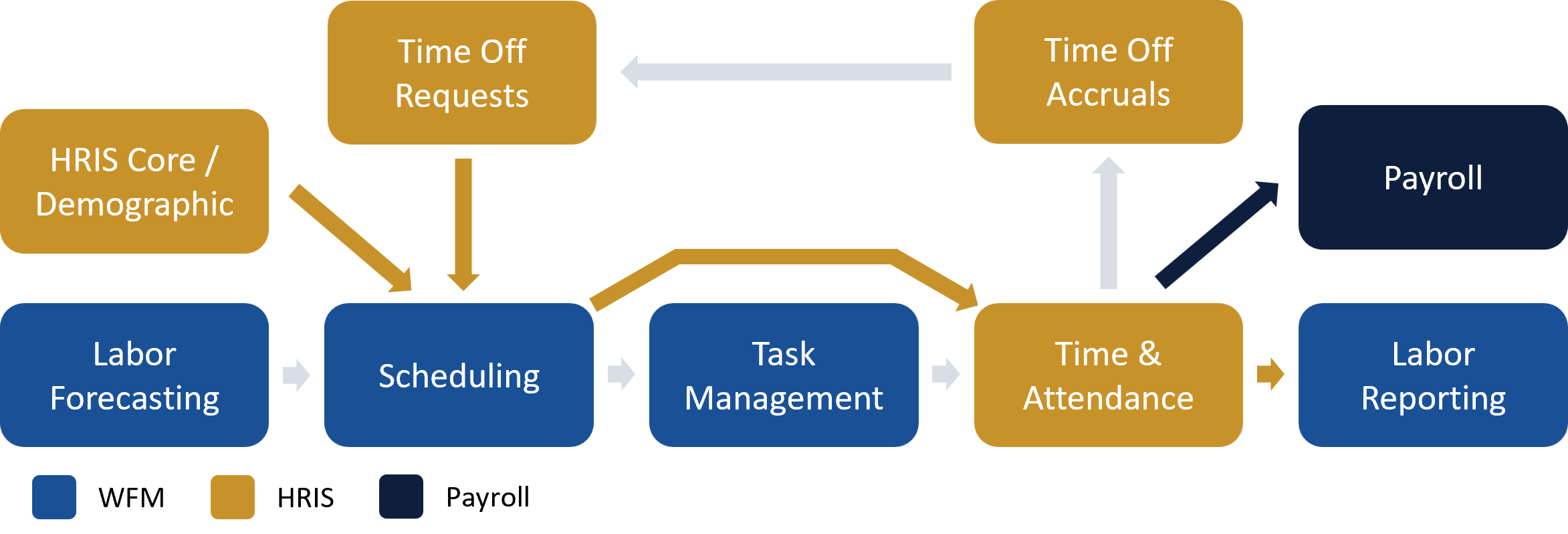
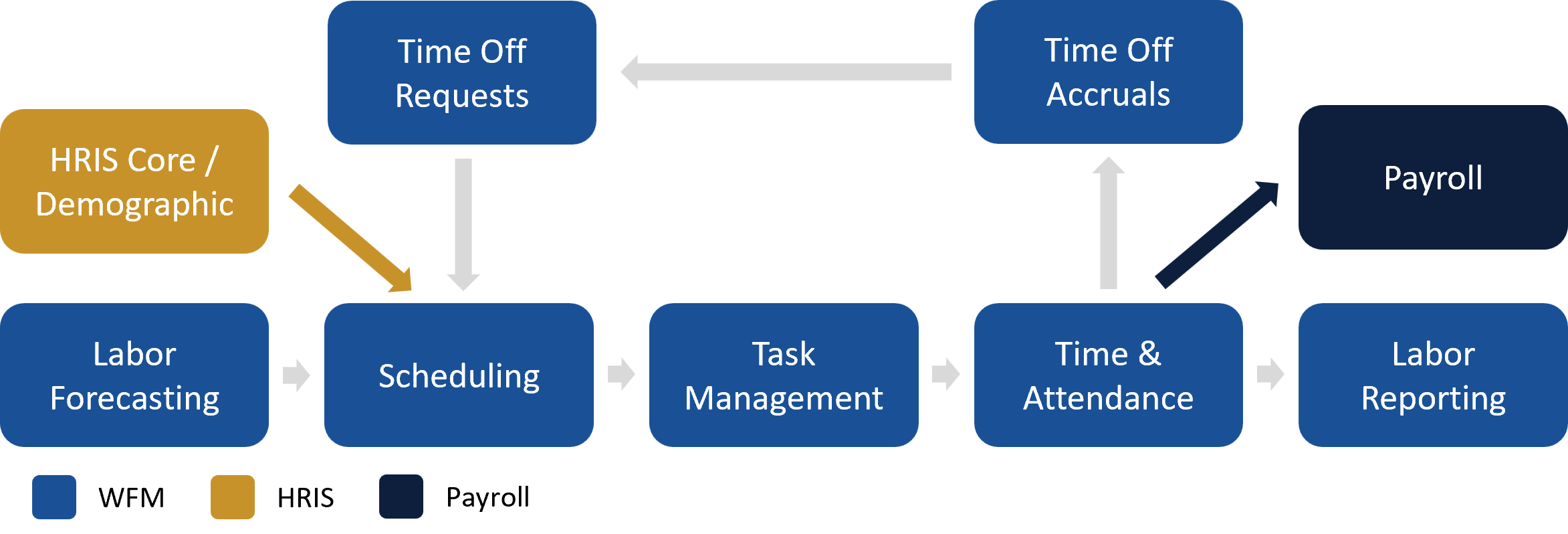
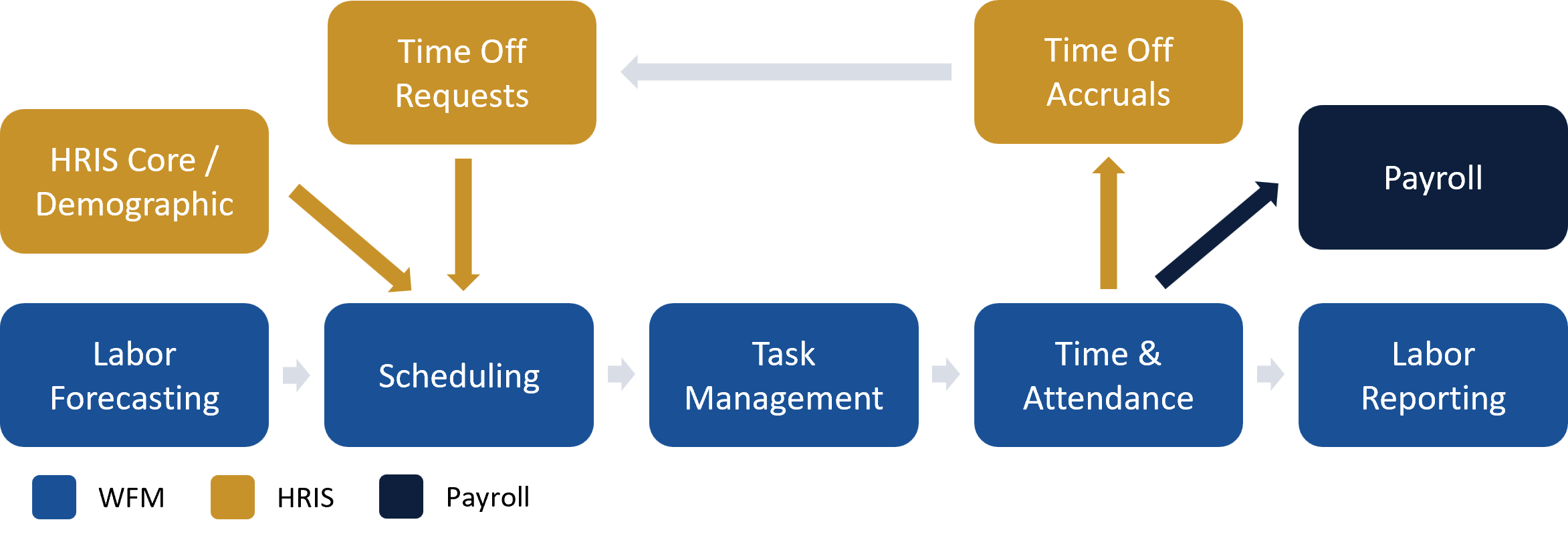
When HR platforms started bundling scheduling tools, it seemed like a reasonable deal. One vendor, one system, less integration overhead. But for operations leaders running complex, demand-driven workforces, that convenience comes with real costs. The worst part is that most of these only become visible after the system is live and the gaps start showing. Here are five reasons to think carefully before relying on a generic, HRIS-bundled Workforce Management (WFM) solution.

01

Compliance and efficiency are not the same goal

HRIS systems are built around HR's primary concern: is this schedule legal? Does it meet policy? Those are important questions, but they are not the same questions Operations leaders need to answer. You need a system that doesn't just flag a bad schedule after the fact. It should guide you toward building a better one, and ideally let you model multiple scenarios before you commit. An HRIS records decisions made elsewhere. A proper WFM system helps you make better decisions in the first place. It will show you coverage gaps across the day, evaluate how well your schedule performs against demand, and will track how effectively employee preferences are being met.

02

Your HRIS can take in demand forecasts. It can't build an operating plan.

Most bundled tools translate a business forecast directly into labor requirements, skipping the entire layer of operational planning in between. That means no task-level sequencing, no visibility into who does what and when. In hospitality, knowing rooms occupied gives you a labor number but not a housekeeping board. That's the day-of operational plan: which rooms get cleaned, in what order, and by whom. That planning happens on paper or in a spreadsheet, and you spend real time keeping everything in sync.

03

Vacation approval is more than a balance check

When an employee requests time off, there are two questions to answer: do they have sufficient balance, and can the operation run without them during that period? Generic systems handle the first question reliably. The second requires longer-horizon capacity planning and the ability to assess, well in advance of schedule-building, whether a given week can absorb planned absences. Without it, approvals are made on intuition, leaving you high and dry when it comes time to build the schedule.

04

Keeping Time & Attendance (T&A) in the HRIS creates a hidden reconciliation cost

T&A feels like a natural fit for an HRIS. It is transactional, it maps to payroll, it belongs in the system of record. But your WFM system needs actuals at a finer level of granularity than the HRIS typically captures, so that labor standards can be continuously refined against real performance. The practical outcome is two systems recording actuals at different levels of detail, and someone, usually an analyst, reconciling them on a recurring basis.

05

Industry-agnostic means optimized for no one

A WFM system built to serve retail, healthcare, logistics, and hospitality from a single codebase has to make compromises everywhere. The configuration options required to handle that range of industries don't disappear. They accumulate in the interface as complexity that your operation has to navigate, even when most of it is irrelevant to you. Simple tasks get buried. Common workflows require extra steps. You pay the complexity cost of problems that aren't yours.

None of this means HRIS-bundled scheduling tools have no place. For organizations with simple, predictable workforce needs, they may be entirely sufficient. But for operations that are demand-driven, task-intensive, or seasonally complex, the gap between what a generic tool offers and what the business actually needs tends to grow over time. It tends to show up in labor cost, operational quality, and analyst hours spent working around the system.

We've seen the full spectrum of WFM solutions and know what works and what doesn't. Reach out to us to get clarity on your WFM platform needs.
Uri Schlafrig
Uri Schlafrig
Founder, Workforce Data Insights
Connect

Your Kitchen Layout Is Making Staffing Decisions You Don’t Know About

Kitchen layout is typically treated as a facilities decision. This analysis makes the case that it’s a workforce planning decision too, and that the staffing implications are significant enough to warrant a seat at the table before the floor plan is locked in.

The design of a physical workspace shapes labor costs in ways that rarely show up in a workforce plan. Aisle width, station placement, the distance between where work originates and where it needs to go are treated as fixed constraints by the time staffing decisions are made. But they’re not neutral. They determine how much time workers spend moving, and how easily the operation can respond when demand shifts.

Kitchens are a clean example of this dynamic. The layout gets locked in early. Equipment vendors have requirements. The hood system goes where the exhaust can reach. By the time anyone asks how many workers the kitchen needs, the floor plan is already fixed. That sequencing embeds a labor cost that never appears on any budget line.

The linear kitchen

The simplest commercial kitchen layout arranges stations in a sequence. Dishes move from one end to the other as they’re prepared, carried along by a conveyor belt. Grill, then fryer, then sauce and finish, then cold prep, then assembly, then expo. Each station in order, each handoff a short step forward.

This layout is efficient for dish movement. The conveyor does most of the work. Backward moves occur when a recipe requires revisiting an earlier station, but they’re typically rare in a well-designed menu and the distance involved is modest.

The labor problem is different. In a linear kitchen, stations are spread across a long, narrow floor. If you want consistent throughput, you can staff each station continuously, but then you’re carrying idle time at every station that isn’t at peak load. Alternatively, you can let workers float: move from wherever they’re caught up to wherever help is needed. Floating is more efficient in theory, but it has a cost. A worker travelling from Expo at one end to Grill at the other end of a 60-foot floor is spending time in transit that isn’t producing anything. In an environment where orders come in surges or prep times vary, that repositioning cost adds up.

The linear kitchen has a fundamental tension: the geometry that makes the conveyor efficient makes labor flexibility expensive.

The 2-aisle kitchen

A 2-aisle kitchen addresses this directly. Stations face each other across a central pass. One aisle handles the hot side, one handles cold prep and assembly. No station is more than a step or two from any other. The maximum distance between any two points on the floor shrinks considerably, and workers covering for each other don’t have to travel far. The cross-aisle geometry also improves sightlines. Workers can see across the pass and are more likely to notice when a station needs help before it becomes a bottleneck.

But the 2-aisle layout introduces a cost the linear kitchen largely avoids. In a linear kitchen, the conveyor handles almost all dish movement. Items flow forward automatically. In a 2-aisle kitchen, whenever a recipe requires a dish to cross from one aisle to the other, a worker has to carry it manually across the pass. That happens every time a hot item finishes on the back aisle and needs to reach an assembly station on the front aisle. For a typical menu mix, that’s most orders.

Representative numbers

The numbers below are synthetic. A modelled six-station kitchen running ten representative menu item families, not data from a real operation. They’re intended to be directionally representative of the trade-off, not to substitute for analysis of an actual menu and demand profile.

For an average item moving through the kitchen from first station to expo, total transport time breaks down as follows.

Linear 2-Aisle
Avg. transport time per item 164s 101s
— of which conveyor 96% 69%
— of which manual 4% 31%

Two things stand out. First, the 2-aisle kitchen’s average transport time per item is roughly 40% lower than the linear kitchen’s. Because stations are physically closer together, items spend less time riding the conveyor between them. Second, 31% of that transport time in the 2-aisle kitchen requires a worker to physically carry the dish, compared to just 4% in the linear kitchen.

The first point matters for throughput. Transport time is transport time. Whether it’s a conveyor or a worker doing the carrying, the item is in transit. On this dimension, the 2-aisle layout is the more efficient design.

The second point matters for staffing. Conveyor moves happen automatically. Manual moves require a worker to be available at that moment. That distinction is largely invisible when demand is uniform and predictable. You can staff for it explicitly. But in a variable environment, the workers responsible for cross-pass moves are also your float pool, and the two demands compete for the same people at the same time.

The trade-off

In a uniform, predictable operation, the float advantage of the 2-aisle layout doesn’t materialise. If demand is stable, you rarely need workers to reposition in the first place. In that environment, the 2-aisle kitchen’s higher manual handling burden is all cost and no benefit. Linear is the simpler, lower-friction choice.

In a variable operation, the picture changes. The 2-aisle layout’s shorter distances and better sightlines reduce the cost of floating. Workers can reach any station faster and are more likely to know when they’re needed. That flexibility has real value when demand is uneven. But it comes with a trade-off: the same workers are also being asked to handle more manual transport, which draws on the same capacity you’re counting on for float coverage.

The net effect on staffing in a variable environment is likely to favour the 2-aisle layout. Better cross-utilisation and lower repositioning cost tend to outweigh the added manual handling burden. But the margin depends on the specific demand profile, the frequency and distribution of cross-pass moves, and how often float demand and cross-pass demand coincide. That interaction is not something a static cost model can resolve. It requires simulation.

What this means

The kitchen is one example of a broader pattern. Physical infrastructure decisions get made early, often without a workforce planning lens, and the labor cost they embed doesn’t surface until the operation is already running.

In some industries — airport terminal design is one — workforce planning does get a seat at the table during facility development. The question worth asking for any scaling operator is whether that conversation is happening at the right stage in your site development process. For an operator standing up multiple locations a year, getting this wrong isn’t a one-time inconvenience. It’s a structural inefficiency baked into every site.

The cost framework in this post applies the flow × distance structure of a Quadratic Assignment Problem cost function to two predefined kitchen layouts, evaluating their relative cost, not optimising station assignment. Six stations, ten menu item families. Conveyor speed assumed at 0.5 m/s; manual carry speed 0.8 m/s, return speed 1.2 m/s. Labor flexibility costs use a float demand proxy derived from station processing loads and idle capacity. The underlying model is available on request.

Uri Schlafrig
Uri Schlafrig
Founder, Workforce Data Insights
Connect